Key Highlights
- It is not just what you own. It is where you own it.
- Good account placement can help now and later with taxes, Roth conversions, RMDs, and retirement income flexibility.
- Done well, proper asset location could improve after-tax results without changing your overall portfolio risk.
At NTX Wealth Partners, one of the more valuable tax planning conversations we have with clients is not just what they own. It is where they own it. That may not sound like a big deal, but it can absolutely affect your annual tax bill. Add that up over 10, 15, or 20 years, and it can make a meaningful difference.
For many of our clients, this comes up during their peak earning years, when they are saving aggressively, paying high tax rates, and trying not to create a bigger tax problem for their future retired selves. Good advisors usually pay attention to these details. Unfortunately, not all of them do it consistently.
Why This Matters for Many of Our Clients
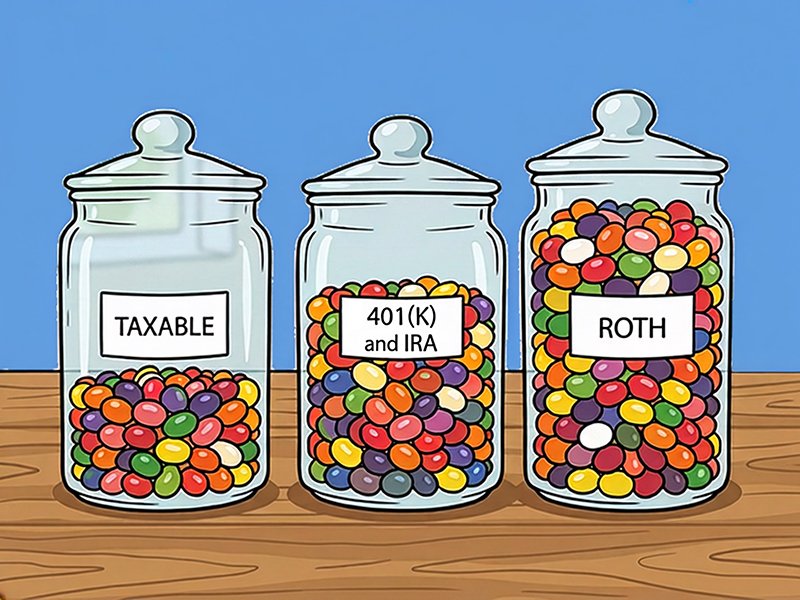
A lot of the families we work with are saving into several buckets at once: 401(k)s, IRAs, taxable brokerage accounts, and sometimes Roth accounts too. That is exactly when asset location starts to matter more.
During these higher-income years, we are trying to reduce unnecessary annual tax drag. Over time, we are also trying to create more flexibility for retirement, when income may look very different.
Asset Location, in Plain English
- Asset allocation = how much you own in stocks, bonds, and cash.
- Asset location = which account owns those investments: taxable brokerage account, traditional IRA or 401(k), or Roth IRA.
- The goal is simple: keep the right overall portfolio mix, then place the pieces in the most tax-aware buckets.
What Often Makes Sense in a Taxable Account
- Broad stock index funds and ETFs
- Growth stocks or lower-dividend stocks we may want to hold for a long time
- Municipal bonds for some high-bracket clients who need fixed income in a brokerage account
Why Can That Work?
- Taxable accounts give us more control over when gains show up.
- Qualified dividends and long-term capital gains are generally taxed more favorably than ordinary income.
- Municipal bonds can make sense for high-income investors who need bond exposure in taxable accounts because interest on many state and local government bonds is generally exempt from federal income tax.
One important nuance:
- Not every dividend-paying stock needs to be kicked out of a taxable account. Qualified dividends are still generally more tax-friendly than bond interest.
- But if an investment throws off a lot of income every year, a pre-tax retirement account may still be the better fit.
What Often Makes Sense in a Traditional IRA or 401(k)
- Taxable bond funds
- High-yield bond funds
- REITs
- Other income-heavy or higher-turnover strategies
Why Can That Work?
- Traditional IRA money is generally not taxed until distribution, which is one reason these accounts can be better homes for investments that would otherwise create more taxable income along the way.
- If a client wants high-yield bonds in the mix, we would usually rather see that tax drag happen inside an IRA than in a taxable account every single year.
What Often Makes Sense in a Roth Account
- If a client has Roth accounts, we often lean toward putting higher-growth assets there.
Why?
- Qualified Roth IRA withdrawals are generally tax-free.
- Roth IRAs do not require lifetime RMDs for the original owner.
- Because Roth space is limited and especially valuable, we usually do not want to waste it on lower-growth holdings if better options exist.
This Is Really a Planning Issue
This is where real financial planning matters. We are not making these decisions based on a rough guess of what someone thinks their income is.
We want to review the tax return, understand the current bracket, and assess what future income might look like from RMDs, Social Security, pensions, and investment income. Then we can decide which bucket may give us the best long-term after-tax result.
We are also looking beyond this year’s return. Today’s account setup can affect future Roth conversion opportunities, future RMDs, retirement income planning, and how much flexibility we have when it is time to start spending from the portfolio.
A Few Caveats
- The investment plan still matters more than perfect account placement.
- Liquidity matters.
- Rebalancing matters.
- Sometimes the tax cost of moving appreciated assets is worse than the benefit of “fixing” the location today.
The Bottom Line
It is not just what you own. It is where you own it. Done well, asset location can reduce annual tax drag and improve long-term after-tax results without changing the overall risk profile of the portfolio.
If your advisor has never walked through which investments belong in which accounts, there is a decent chance some tax-saving opportunities have been left on the table. That is exactly the kind of thing we help clients evaluate all the time, especially for families trying to save aggressively now without creating a bigger tax mess later.
Any opinions are those of Rob Hrnicek and not necessarily those of Raymond James. Expressions of opinion are as of this date and are subject to change without notice. Raymond James and its advisors do not offer tax or legal advice. You should discuss any tax or legal matters with the appropriate professional.
