Key Highlights
- The years between retirement, Social Security, and RMDs can be prime time to convert IRA dollars at lower tax rates.
- The best results usually come from a multi-year plan that coordinates Social Security timing, Roth conversions, and future tax brackets.
- For many retirees, the better Social Security question is whether delaying benefits creates a cleaner Roth conversion window first.
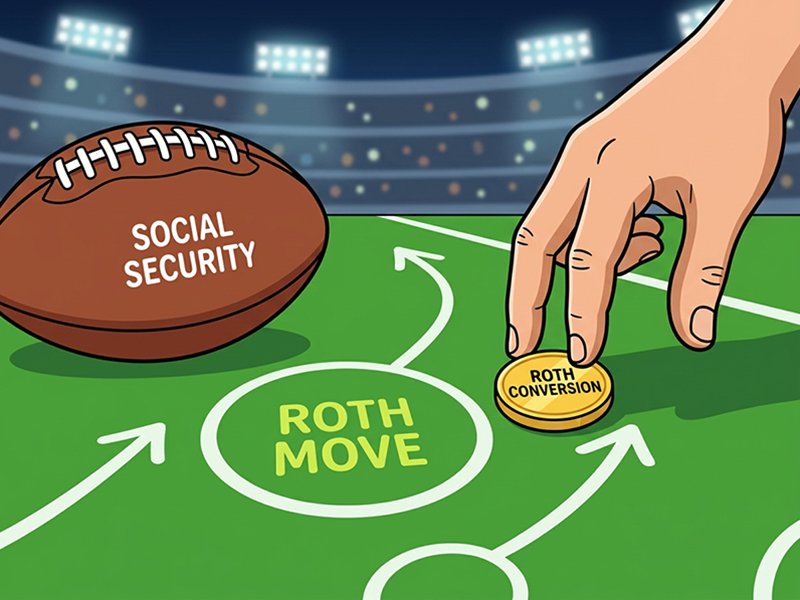
For some retirees, delaying benefits is not just about a bigger check later. It may also create a valuable Roth conversion window before Social Security and RMDs begin.Most people look at Social Security and ask one question:
“Should I take a smaller check sooner or a bigger check later?”
Fair question. But for a lot of the people we work with, especially those heading into retirement with a sizable traditional IRA, that is not the best question. A better one is this:
“Would delaying Social Security give us a better chance to convert IRA money to a Roth IRA at lower tax rates first?”
That is where this gets interesting.
The Tax Window Most People Miss
For many retirees, there is a stretch of time after work slows down or stops, but before Social Security starts and before required minimum distributions begin. Those years can be a big planning opportunity.
Why? Because income is often lower, the tax return is not as crowded yet, and there may be more room to convert part of a traditional IRA to a Roth without getting pushed into a higher bracket than necessary. Under current rules, Social Security benefits keep increasing if you delay after full retirement age, but only until age 70. Traditional IRA RMDs generally begin at age 73 for many current retirees. That gap is what we are trying to use wisely.
Why Delaying Social Security Can Help
Once Social Security starts, it is not just extra money. It is also more income on the return, and depending on your overall income, up to 85% of your Social Security benefit can be taxable. Then later, RMDs show up and add even more taxable income whether you need the money or not.
That is when doing Roth conversions often gets tougher. Not impossible. Just tougher.
So for some retirees, delaying Social Security is not just about getting a bigger benefit later. It is also about keeping the tax return cleaner for a few years so we can do Roth conversions more efficiently now. That is the move.
What This Can Look Like in Real Life*
Let’s say a couple retires in their mid-60s. They have a good-sized IRA. They do not need Social Security right away. They have other assets they can use for living expenses for a few years, maybe cash, a taxable account, part-time income, a pension, or some combination of those.
That may give us a really nice window to start moving money from the traditional IRA to the Roth IRA before Social Security and RMDs start stacking up.
Done thoughtfully, that can help:
- Reduce future RMDs
- Reduce future taxable income
- Create more tax-free flexibility later
- Give them more control over their tax bracket in retirement
Then when Social Security starts, they may have a larger monthly benefit and a smaller IRA balance still waiting to cause trouble. That is a pretty good combo.
This Is Not a “Convert the Max” Strategy
This part matters. The goal is not to convert the maximum amount possible. The goal is to convert the right amount. There is a big difference.
Usually, we are trying to fill up a tax bracket on purpose without spilling into the next one just because we got a little too ambitious. The IRS is not handing out trophies for unnecessary enthusiasm.
That is why the best Roth conversion plans are usually not one-year hero moves. They are multi-year plans.
You look at income now, future Social Security, future RMDs, cash-flow needs, and how the taxes will actually get paid. Then you decide how much room you really have. Some advisors pay close attention to that. Some do not. We think they should.
When This Idea Tends to Make the Most Sense:
- Is retiring before age 70
- Has a meaningful traditional IRA balance
- Does not need Social Security right away
- Wants to reduce future RMD headaches
- Has other assets available to help cover the taxes on conversions
That does not mean everybody should delay Social Security. If you need the income now, have health concerns, or do not have a good way to pay the tax bill that comes with Roth conversions, the answer may be very different. This is not a rule. It is a planning conversation.
One Practical Reminder
If you delay Social Security, do not confuse that with delaying Medicare decisions. Benefits stop increasing at age 70, and if you delay retirement benefits, you still need to pay attention to Medicare around age 65. That is one of those details that is easy to miss and annoying to fix later.
Bottom Line
For some retirees, delaying Social Security is not just about getting a bigger check later.It is about creating a better Roth conversion window before Social Security and RMDs begin.
And if that window lets you move more money out of a traditional IRA at lower tax rates, that can make a meaningful difference over the rest of retirement. That is why we like to look at Social Security timing and Roth conversions together, not as two separate decisions living on two separate islands.
Want help running the numbers?
*This is a hypothetical story and not indicative of any specific situations or client. It is presented only as an example and not intended as investment advice. Investing involved risk and there is no assurance that any investment strategy will be successful.
