Key Highlights
- A good Roth conversion is not a gut call; it is a math problem that you want to solve correctly.
- Conversion years are typically best when taxable income is lower, not at peak earnings.
- In the right year, a Roth conversion can lower taxes for your family and prevent issues later.
This is Part 2 of a 2 part series on Roth planning.
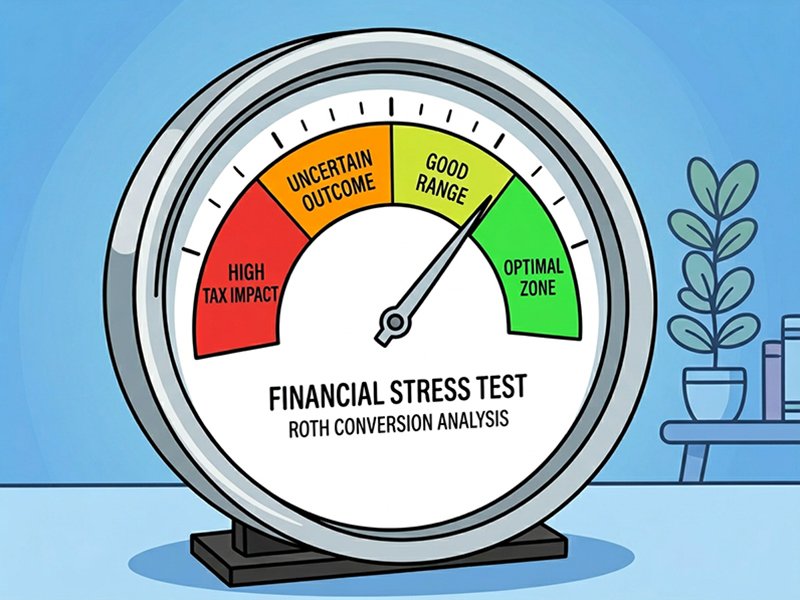
Roth conversions are powerful. They are also easy to get wrong. Before we recommend moving money from a Traditional IRA to a Roth IRA, we run what I call a Roth Conversion Stress Test. Here are ten things we always evaluate before making a decision.
1. Your Marginal Tax Bracket
Start here. What bracket are you in today? What bracket are you likely to be in later?
If you’re converting at 12% today to avoid paying 22% later, that’s compelling. If you’re converting at 32% today, betting taxes will go up someday, that’s a harder sell.
2. Medicare IRMAA
Higher income can increase Medicare Part B and Part D premiums. These surcharges are based on prior-year income. Sometimes it still makes sense to trigger IRMAA. Sometimes it doesn’t. We model both.
3. ACA Health Insurance Subsidies
For early retirees on marketplace insurance, higher income from conversions can reduce or eliminate premium subsidies. This is one of the most commonly overlooked conversion costs.
4. State Income Taxes
Are you planning to move to a no-tax state? Converting before or after a relocation can materially change the math.
Are you currently in a high-tax state? Living in Texas, it’s easy to overlook this when speaking with out-of-state clients, so we always add it to our checklist when evaluating potential conversions.
5. Social Security Taxation
Conversions can increase how much of your Social Security becomes taxable. This doesn’t automatically kill the strategy, but it affects the net result.
6. How You’re Paying the Tax
Pay conversion taxes with non-IRA funds. Using IRA dollars to pay the tax bill from conversion reduces the amount that goes into the Roth and may trigger penalties if under age 59½.
7. Future RMD Impact
How large are projected RMDs if you do nothing? Large IRA balances can create forced income later that pushes you into higher brackets, increases Medicare premiums, and limits flexibility. Reducing the IRA earlier can help smooth lifetime taxes.
8. Beneficiary Situation (Tax Rate + Timeline)
Who’s inheriting the IRA matters. Most non-spouse beneficiaries have a limited window to withdraw inherited IRA funds, often up to 10 years, which can stack taxable income during their peak earning years.
So we compare your tax rate today if you convert versus their likely tax rate later if they inherit a large traditional IRA. In many cases, a Roth conversion shifts future taxes from your beneficiaries back to you, at a lower rate and on your schedule.
9. Market Conditions
Market downturns can create opportunities. Converting when values are temporarily depressed means future recovery may happen inside the Roth. No one times markets perfectly. But valuation matters.
10. The Five-Year Rules
Roth rules come with a couple of five-year clocks. The one that bites people is this: if you convert and then pull out those converted dollars too soon, you can get hit with a 10% penalty (usually only an issue if you’re under 59½). We make sure the timeline works before we recommend a conversion.
When We Often Recommend Waiting
- Peak earning years
- Large one-time income events
- Years when a conversion creates expensive subsidy or Medicare cliffs
- Situations where charitable strategies may offset future RMDs instead
The Big Picture
A Roth conversion is not about chasing headlines or predicting future tax law. It’s about optimizing lifetime taxes and spending more years in lower tax brackets to avoid higher tax rates in higher-income years.
Some years are clearly the best of times. Others are clearly not. If you’re nearing retirement, recently retired, or wondering whether you’re in your own Income Valley of Opportunity, let’s run the stress test together. The goal isn’t to convert everything. The goal is to reduce the taxes you and your family pay over your lifetime without creating avoidable surprises along the way.
Unless certain criteria are met, Roth IRA owners must be 59½ or older and have held the IRA for five years before tax-free withdrawals are permitted. Additionally, each converted amount may be subject to its own five-year holding period. Converting a traditional IRA into a Roth IRA has tax implications. Investors should consult a tax advisor before deciding to do a conversion.
